

Beyond the Herbs: A Trauma-Informed Approach to Wellness
Posted by Cheryl Cryer on Mar 11th 2025
Beyond the Herbs: A Trauma-Informed Approach to Wellness
Wellness is not always about adding something.
Sometimes it is about creating enough safety, space, and support for someone to listen to what their body is already telling them.
That idea has become increasingly important in the way we think about wellness at Urban Apothecary.
People do not walk through the door as blank slates. They may be carrying stress, caregiving, grief, burnout, health concerns, difficult experiences, or responsibilities that are not visible from the outside.
That changes how we listen, communicate, and think about support.
What Does “Trauma-Informed” Mean?
A trauma-informed approach does not mean assuming everyone has a trauma diagnosis, and it does not mean trying to become someone’s therapist.
At its core, it means recognizing that past and present experiences can shape how people respond to stress, environments, relationships, healthcare, touch, language, and decision-making.
In a wellness setting, that can look like:
- giving people choices
- avoiding pressure
- explaining what to expect
- respecting boundaries
- asking before making assumptions
- allowing people to move at their own pace
It is less about having the perfect script and more about creating a respectful environment.
Choice Matters
People should feel that they can say:
- yes
- no
- not yet
- I am not sure
- I need more information
- I want something simpler
That applies in wellness too.
We do not believe in pushing people toward the biggest supplement stack or the strongest product.
Sometimes the most supportive thing is helping someone narrow the options.
Sometimes it is telling them they do not need anything at all.
Language Matters
Wellness language can carry more weight than we realize.
Words like fix, heal, cure, broken, detox, control, should can feel loaded.
At Urban Apothecary, we try to use language that leaves room for the person.
That often means words like:
- support
- explore
- consider
- notice
- build
- try
- routine
- ritual
- comfort
The goal is not to make wellness vague.
The goal is to make it more human.
You Do Not Have to Share Your Story
A person should not have to disclose deeply personal experiences in order to ask a question about sleep, stress, movement, herbal tea, body care, or a daily routine.
Curiosity is enough.
A simple question is enough.
Support should not depend on disclosure.
Start With the Basics
When life feels overwhelming, people often reach for something that promises a fast reset.
But sometimes the most supportive place to begin is more basic:
- sleep
- food
- hydration
- movement
- time outside
- fewer commitments
- quiet
- boundaries
- connection
- professional support when needed
Those things are not flashy.
They are often foundational.
Where Herbs Can Fit
Herbs can absolutely have a place in a wellness routine.
A tea can become part of an evening ritual.
An aromatic product can make a space feel more intentional.
A topical can become part of a body-care routine.
The key is context.
What else is happening?
What medications is the person taking?
What are they hoping for?
What actually feels manageable?
Herbs should fit into the whole picture, not replace it.
explore our herbal tea collection
simple sensory and body-care rituals
Community Can Be Part of Wellness Too
Support does not always come from a product.
Sometimes it comes from:
- a conversation
- a class
- a walk
- a support group
- a trusted practitioner
- a community event
- a friend
That is one reason community education has become such an important part of Urban Apothecary.
We want the shop to be more than a place where people buy things.
We want it to be a place where people can learn, connect, ask questions, and feel comfortable doing so.
Trauma-Informed Does Not Mean Treating Trauma
There is an important boundary here.
Urban Apothecary is not a mental-health clinic, and herbalists are not substitutes for licensed therapists, physicians, or other qualified professionals.
A trauma-informed approach means we try to make our space and communication more respectful and aware.
It does not mean we diagnose trauma, provide psychotherapy, or treat mental-health conditions.
If someone is dealing with significant distress or an ongoing mental-health concern, professional support may be appropriate.
That boundary is part of responsible wellness too.
Small Changes Can Matter
Wellness often becomes more sustainable when it gets smaller.
Instead of changing everything, maybe you:
- go to bed 30 minutes earlier
- take one walk
- drink more water
- make tea before reaching for your phone
- say no to one thing
- ask for help
- book the appointment you have been putting off
Those changes may not look dramatic from the outside.
They can still matter.
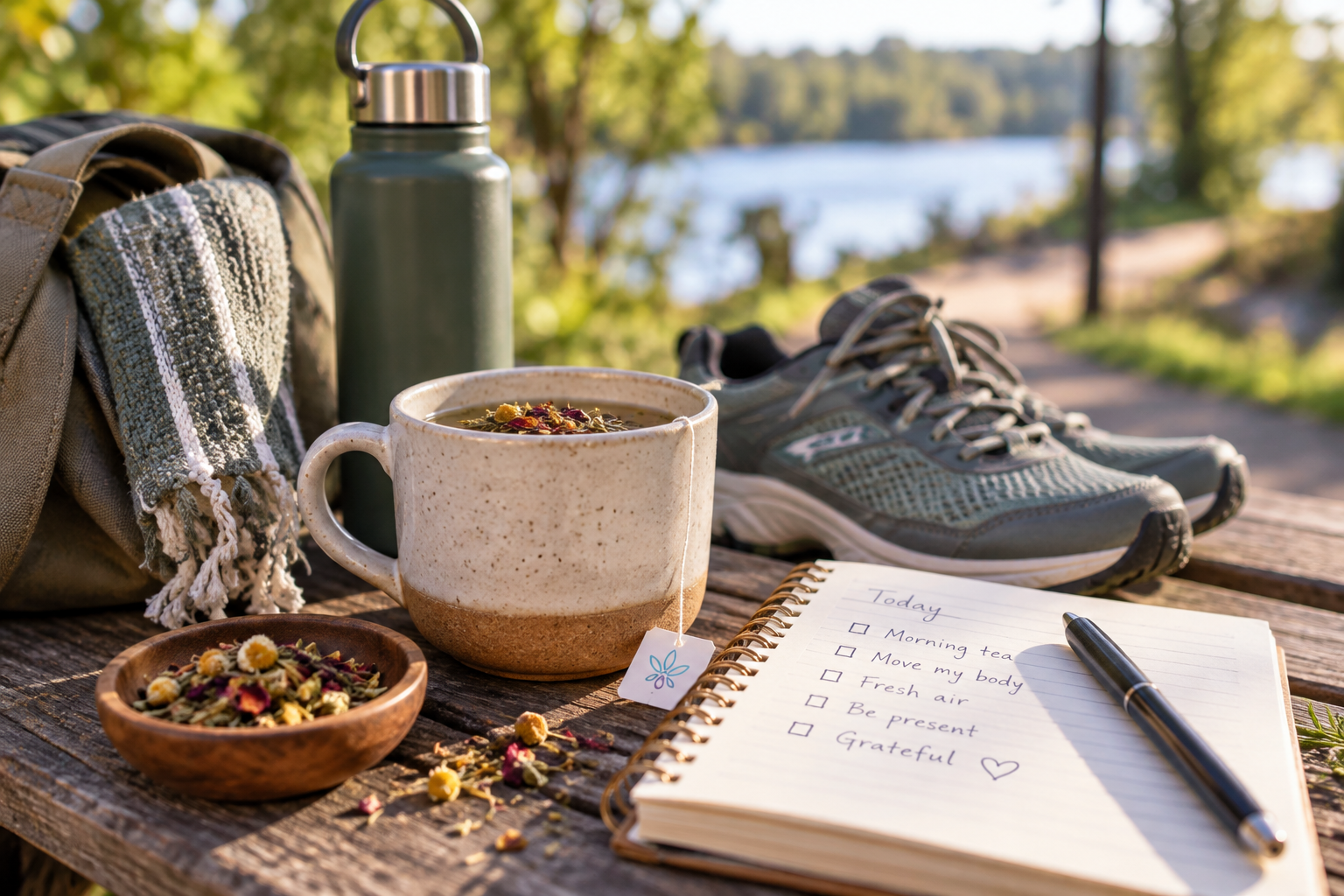
Herbal tea, walking shoes, a journal, and a water bottle arranged on a bench beside a peaceful outdoor trail.
Final Thought
A trauma-informed approach to wellness is not about having all the answers.
It is about listening more carefully, giving people choices, avoiding pressure, respecting boundaries, and remembering that wellness is personal.
Sometimes the most useful support is not another thing to buy.
At Urban Apothecary, that is the kind of space we are trying to create.